















Just a few years ago, when we made a relatively big shift in our diet to eat better, I had a really difficult time trying to wrap my head around the fact that I needed to bake less.. or change my ingredients, as baked goods often correspond with sugar. Lots of sugar.
You see, I LOVE to bake. I love to cook. I can make anything, everything, and could honestly spend all day in the kitchen without hesitation. Baked goods are something we ate a great deal as kids – and with baked goods comes .. . Flour.
And as a kid, I thought all flour was the same.
It wasn’t until about 5-6 years ago that I discovered that flour is NOT all the same – I think most people know that flour isn’t the best for our health. But when you talk about flour, there are different types of flour. Some flour is bleached, and some is not bleached.
And bleached flour is probably even worse than anything. I buy my flour 15 – 20 bags at a time, and it usually lasts for MONTHS if not the entire year, depending on what we bake. That comes with quirky comments when people visit and see your pantry stocked full of dry beans, and lots of flour – and prompts people to ask “why do you buy THAT flour?”
That, referring to the blue bag. Bob’s Red Mill. Which we buy in bulk to get the best price.
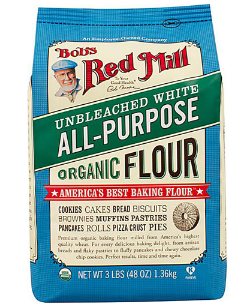
Vitacost always has Bob’s Red Mill Unbleached (and NOT enriched) All Purpose Organic Flour – it’s always a great price.
Years and years back, ALL flour was unbleached. The flour came out as a pale yellow color and was aged for a period of 12 weeks – that aging process allowed for proteins and glutens to develop – essentially making it great for baking. As it aged, the flour became whiter – naturally though.
Over time, convenience set in, and much similar to the “I want it now” mentality we have now, people didn’t want to wait 12 weeks for the flour to naturally whiten. It was at that time that a scientist invented a process to speed up that aging time from 3 months to just 48 hours – that process involved using chemicals to bleach the flour.
The Beginning of Bleached Flour
Dr. Wiley was one of the doctors at that time that was most opposed to bleaching flour. He believed so strongly that he went to the Supreme Court to call attention to the fact that he thought bleaching was uncalled for.
And the Supreme Court listened.
But, they never enforced.
At that same time… the FDA was ALSO formed and their focus was on drugs and prescription medicine – and eventually bleached flour continued with time. Right now you can find bleached flour sitting RIGHT there on the grocery store shelf, in a much larger area than unbleached – right?
How White Flour is Made
If you haven’t ever wondered how flour is made, it’s a really interesting process. If you do a lot of baking or cooking like I do, then it might intrigue you to discover just how involving the process is.
And just how worrisome too..
Commercial wheat production starts with seeds being treated in fungicide.
Once they become wheat, they are further sprayed with pesticides and hormones – to include the bins that store the wheat that is harvested. Their goal? To protect against bugs – which can appear in storage. Just like bugs can appear in your pantry.
The whole “grain” of wheat, holds 3 parts or “layers” – the Bran, the Germ and the Endosperm.
- Bran: The hard outer layer of the shell of the kernel and where all the fiber is kept
- Germ: The nutrient rich embryo that sprouts into a new wheat plant
- Endosperm: 83% of the grain, and mostly starch
White flour is made of purely the endosperm; whole wheat flour combines all 3 parts (Bran, Germ and Endosperm).
Just like pasteurized industry milk is highly processed, so is flour – the flour mills that produce our flour today mass produce flour in such large quantities, that flour loses a great deal of nutritional value. To make matters worse, the white flour is even more processed, as it gets smacked with a bath in chlorine (to whiten).
This is worth mentioning – and you can read the full article HERE.
“Today, the US milling industry produces about 140 million pounds of flour each day, so there is no way to store the flour to allow it to age naturally. Plus there is a shelf life issue, says Bair. So chlorine gas is used to oxidize (or age) soft wheat flours and impart the same baking performance that natural aging would accomplish.”
The Problem with Bleached Flour
The bleaching of flour is a chemical process, that produces a byproduct called alloxan – that same byproduct is used to produce diabetes in lab rats and mice, to allow the study of diabetes treatments. Oddly enough, the FDA allows still allows chemical processes to be used. You can read more about Alloxan here.. it’s something to think about.
And just like the pasteurization of milk destroys valuable nutrients and enzymes/probiotics, MANY nutrients are lost when flour is bleached.
The bleaching process involves several chemical agents:
- Chlorine Dioxide
- Nitrogen Dioxide
- Calcium Peroxide
- Benzoyl Peroxide
Just like pasteurized milk that is heated to high temps and nutrients are re-added in, the SAME thing happens with flour. The nutrients and vitamins that are lost during that chemical transitional process are re-added – which is why flour is termed “enriched”.
Unfortunately … it’s hard to actually replace all that is lost, and most of the nutrients are still missing, not to mention your body has a difficult time with synthetic versions – they don’t quite work the same.
Even more.. when these synthetic nutrients are added back in, they are also joined by toxic additives — like metallic iron fillings.
Unbleached Flour
Unless your bag of flour is labeled unbleached, it’s bleached. Many people may just pick up flour off the shelf without a second thought – not even realizing the implications of bleached vs. unbleached – I know I never realized there was a difference until i started to study it myself.
Unbleached is the preferred choice – simply because it has more nutrients and hasn’t been chemically altered. It’s always a good choice to buy Organic flour too — so aim for Organic, Unbleached, Unenriched flour for the BEST option.
While you might think that Whole Grain Wheat is the better option, Wheat tends to have more pesticides than unbleached, unenriched {organic} white – and the practice of drenching wheat in pesticide is becoming fairly popular in the United States.

[…] believe, right? We buy Organic All Purpose Unbleached Flour (many reasons why – you can read HERE for more!) What makes the bread puff is is the combination of water (turning to steam) and […]