


I am somewhat picky about where I buy my meat – although I will occasionally buy meat at Costco (grass-fed, Organic ground beef) – it’s rare. In the last 12 months I have have only purchased 5 pounds, we have really done well with cutting back our meat consumption. It’s not that I think meat is bad for you it’s just something we felt like we needed to cut back on in our diet and it hasn’t really been too difficult.
I never buy meat from the grocery store… and my ideal goal is to buy it from farms only. Although one day I’d love to produce it ourselves – but that’s a few years down the road.
We recently bought two pastured chickens from a local family farm in Cave Creek – these chickens were raised on the family farm, on pasture, and supplemented with organic feed without soy.
While it might be easier for most to just head to their grocery store or meat, the thought of buying meat that was more than likely the result of a feeding operation is daunting. Do you ever think about that?
MOST meat in the United States is raised in confined animal feeding operations (CAFO’s) – it’s a confined operation, that is controlled by climate, and is the cheapest way to raise meat for profit. Food production allows CAFO’s to produce MORE for less, through low profit-margin production, processing and distribution. Our government subsidizes these operations, which often involve large feedlots of animals crammed into smaller spaces.
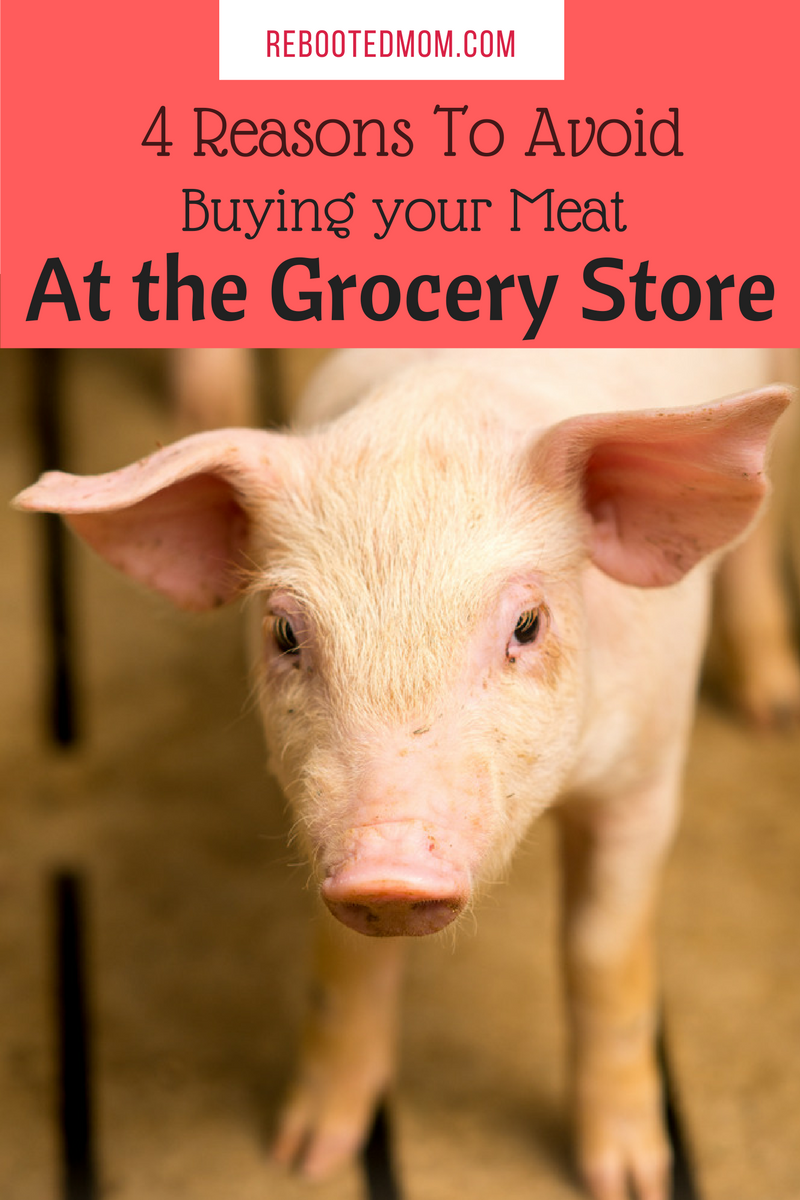
Here are the reasons I avoid buying meat at the grocery store:
#1 – Concentrated Animal Feeding Operations Contribute to Pollution of Land and Water
Even the smallest concentrated animal feeding operations produce some pretty hefty amounts of urine and feces – the equivalent to 16,000 humans. The waste is usually dumped into one of several piles on the operation – piles for feed and piles for manure. The manure is usually dumped into a lagoon on the property – which overflows when it rains.
That manure then pollutes the local water supply with the residue from the antibiotics.
They [CAFO’s] produce about 65 percent of the manure from U.S. animal operations, or about 300 million tons per year—more than double the amount generated by this country’s entire human population. For the purposes of this report, there are approximately 9,900 U.S. CAFOs producing hogs, dairy cows, beef cows, broiler chickens, or laying hens. (Src)
#2 – Meat from Animals in Confinement Operations is not Healthy
Meat from animals raised in Confined Animal Feeding Operations is nowhere near as healthy as pastured meat
These animals are the source of conventional meat, and processed milk – they are squashed together in small spaces, many walk amidst their own feces, and they have a horrible diet with drugs and antibiotics given to them to keep them alive so that they can be slaughtered.
Take a road trip past Cargill Farms in Texas, OR… the pig farms in Kansas and you might just agree that the pounds of waste that are excreted are a hazard to the air. It’s pretty disgusting to say the least.
One of the techniques used in factory farms is giving the animals a dose of antibiotics with every meal to help the animals increase in weight – at a faster rate. Over time, the bacteria in the animals guts are killed and bacteria start to become resistant to antibiotics. Even worse, the unnatural diet and heavy antibiotics in the gut of the cow create an acidic environment that allows e.Coli to flourish (as well as other diseases).
A diet high in Soy (which is a phytoestrogen) is not healthy either – we have discussed the health effects of consuming an abundance of Soy – it creates chickens with lovely HUGE breasts that raise your risk of several cancers.
Grass-fed beef is free of hormones, free of antibiotics, and high in health enhancing fats (Omega 3, Omega 6 and Vitamin E, C & more). Because the cows are not pent up in Confined Operations, they are not as stressed – as a result the meat is more tender, fresher – and the reasons behind that you can read about HERE.
Not only is it better for you, it’s just better in general – since grazing cattle get exercise and aren’t fattened with grain/corn, their meat is lower in fat and has less marbling – the meat tends to have more flavor, too.
#3 – Factory Farmed Meat Lacks Flavor
Pastured meat will have more flavor than factory farmed meat because the animal was fed a wider variety of natural foods (including pasture. The animals also have a chance to roam/move around and work out their muscles.
#4 – Factory Farmed Meats are Not Sustainable
Raising meat is expensive – no matter which way you do it. Raising poultry in a chicken house is expensive to do – $200,000 chicken houses have high costs of electricity, and manure clean up – many of these confined operations are supported with your tax dollars through subsidies. So many of those farmers are barely making an income – not only are they in debt with their chicken house they can barely afford to keep the electricity going and the lights on.
It has been stated that smaller operations can be cost effective and produce ample animal products –
CAFOs have been indirectly supported by huge taxpayer-funded subsidies that compensated grain farmers for excessively low prices. Because feed makes up such a large part of CAFOs’ costs, lower grain prices can have a big impact on the total cost of production. (Src)
Government subsidies are what allow these CAFO’s to continue – the subsidies allow them to purchase corn and soybeans at low prices – lower than what it costs to grow the crops. Family farms don’t receive subsidies for raising animals on pasture – so these larger CAFO’s outcompete their smaller counterparts.
Think Buying from a Farmer is Expensive?
In some cases, it might be – but buying direct will ensure you know how the animals were raised, therefore allowing you to know exactly what you are eating.
I’ll admit that buying pastured chicken from a local farm is going to be more – but in the case
Buying your Meat directly from a farmer is not only more satisfying, it gives you the chance to meet the person who raised the animal – it gives you the chance to ask questions on the meat you will be ingesting. Not only that, it gives YOU control of your food at a price that might just be more favorable than the supermarket.

Leave a Reply